

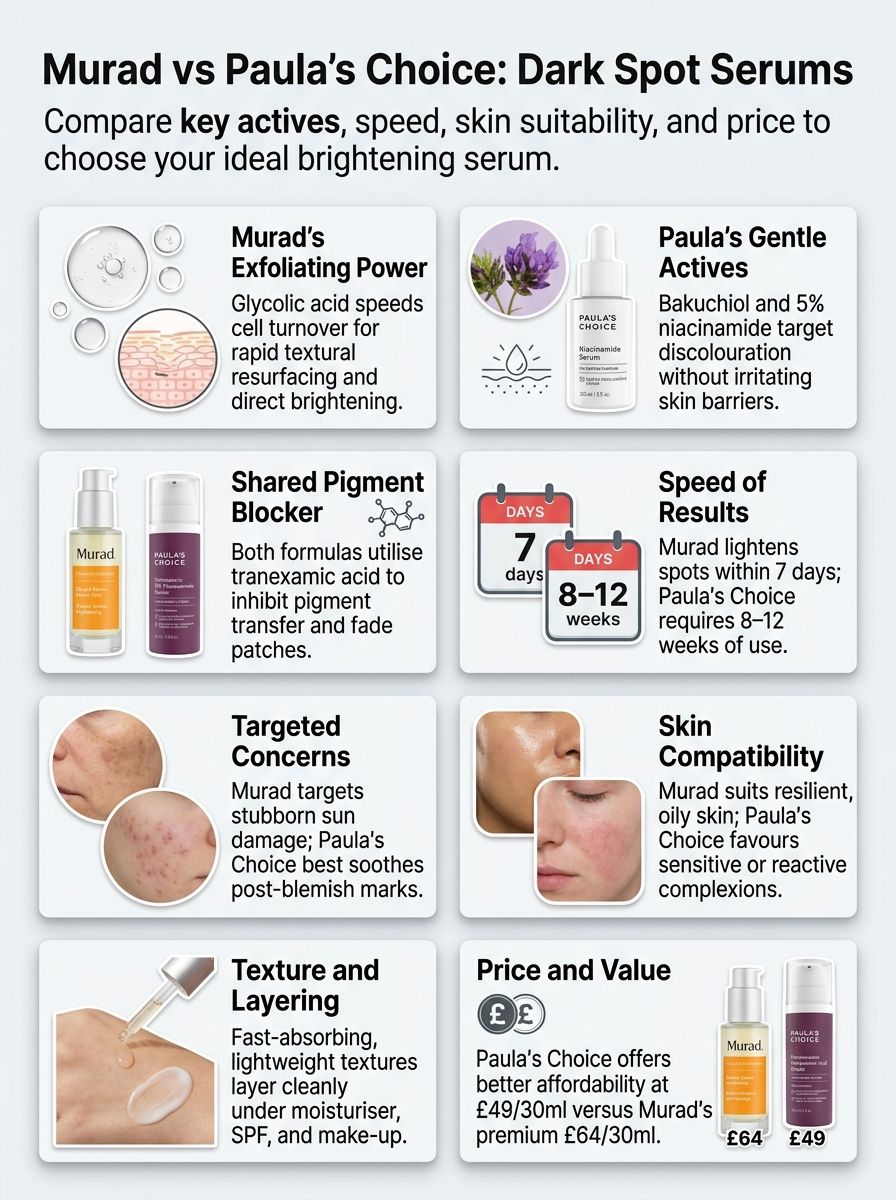
You know how dark-spot shopping gets confusing fast: two products can both promise brighter skin, yet one may suit your routine far better than the other. In this Murad vs. Paula’s Choice Dark Spot Serum comparison, the key difference is that Murad combines exfoliating glycolic acid with tranexamic acid, while Paula’s Choice takes a slower, barrier-friendlier approach with 3% tranexamic acid, 5% niacinamide and 0.5% bakuchiol.
That distinction matters because brown spots can worsen when skin becomes irritated or gets repeated UV exposure.
Below, you’ll see how the formulas, expected results, texture, tolerance and UK pricing compare, so you can choose a dark spot serum that fits your skin rather than chasing the fastest claim on the bottle.
Key Takeaways
- Murad Rapid Dark Spot Correcting Serum is the faster, more intensive option. It uses glycolic acid, tranexamic acid and 4-ethylresorcinol to work on visible pigmentation and rough texture at the same time.
- Paula’s Choice Clinical Discolouration Repair Serum contains 3% tranexamic acid, 5% niacinamide and 0.5% bakuchiol. It is better suited to people who want a fragrance-free formula and a more gradual approach.
- Murad lists visible dark-spot improvement from seven days, while Paula’s Choice advises allowing 8 to 12 weeks of daily use. These are different testing standards, so treat them as useful expectations rather than a guarantee.
- Murad’s 30 ml bottle is listed at £83 in the UK, compared with £55 for Paula’s Choice. Paula’s Choice offers the lower cost per ml and a 60-day return window on direct purchases.
- Both formulas need daily broad-spectrum SPF. Without consistent sun protection, fresh pigmentation can undo the progress made by any dark spot corrector.
Overview of Murad Rapid Dark Spot Correcting Serum
Murad Rapid Dark Spot Correcting Serum is built for people who want to tackle dark spots, uneven skin tone and dull texture in one step. Its formula combines pigment-focused ingredients with glycolic acid, an alpha hydroxy acid that lifts dull surface cells.
The trade-off is clear: it has a more active feel than Paula’s Choice, but it also contains alcohol denat. and fragrance components. If your skin reacts easily, introduce it carefully rather than starting twice a day.
Key ingredients (Murad Serum)
Murad uses a multi-active formula rather than relying on one headline ingredient. The official ingredient list places glycolic acid high in the formula, followed by glycerin, tranexamic acid and 4-ethylresorcinol.
- Glycolic acid: This alpha hydroxy acid exfoliates the skin’s surface. It is useful if your marks sit alongside rough texture, clogged pores or a dull finish.
- Tranexamic acid: This brightening active targets uneven pigment pathways. It is a sensible choice for post-blemish marks and sun-related brown spots.
- 4-ethylresorcinol: Murad calls this its patented Resorcinol Technology. It supports the serum’s focus on the look of stubborn dark spots and uneven tone.
- Glycerin and urea: These humectant ingredients help draw water into the outer skin layer, which can make an exfoliating formula feel less drying.
- Allantoin and zinc gluconate: These ingredients support a calmer skin feel, though they do not cancel out the irritation risk of glycolic acid, alcohol or fragrance.
A practical point: Murad contains PEG-40 hydrogenated castor oil, alcohol denat., limonene, linalool and fragrance. Do not choose it on the assumption that it is fragrance-free or alcohol-free.
How it works (Murad Serum)
Murad works through two routes. Glycolic acid helps shed dull, pigmented surface cells, while tranexamic acid and 4-ethylresorcinol focus on the look of excess pigment before it becomes more visible.
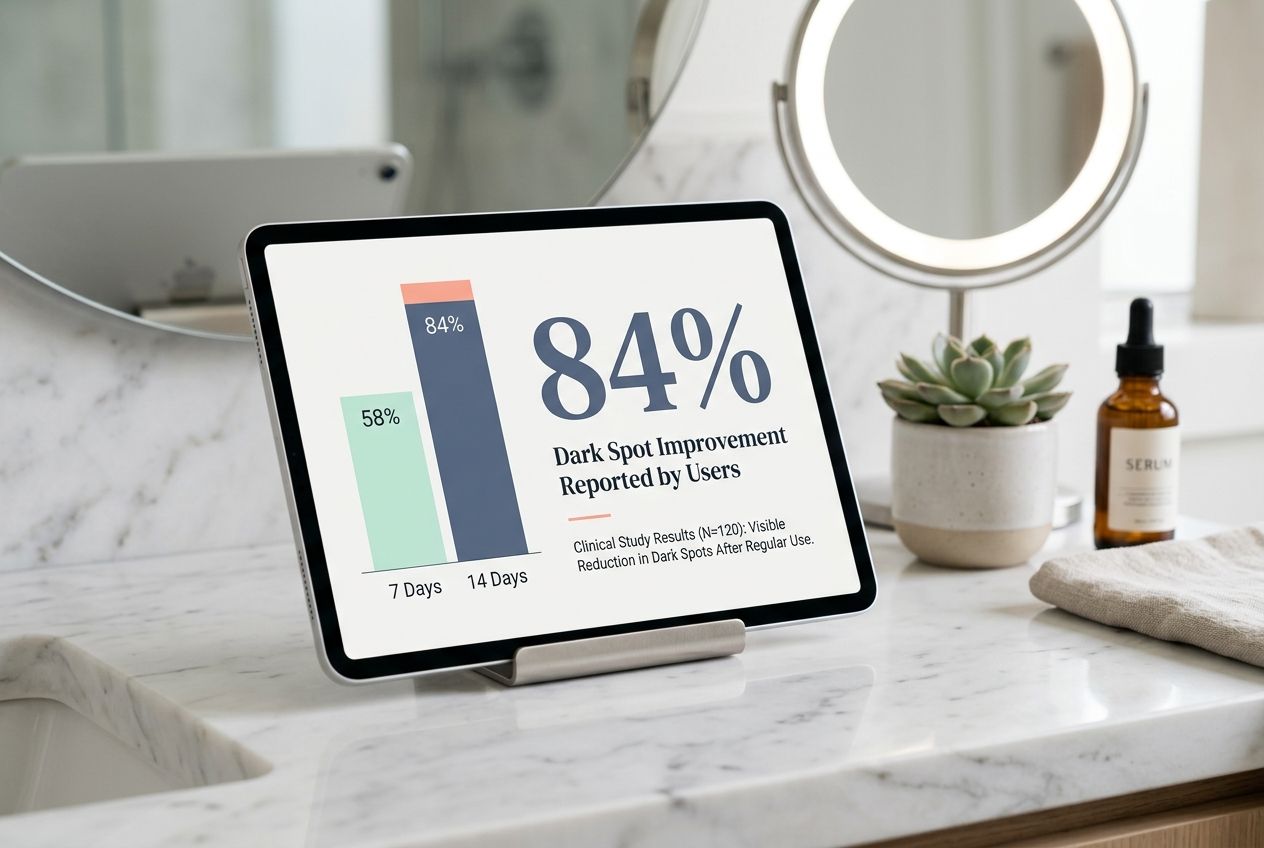
In its current UK product information, Murad says the serum improves the look of dark spots in seven days. It also reports that, after 14 days with a Murad regimen, 84% of participants showed a reduction in the look of dark spots.
Murad is the stronger choice if texture and visible brown marks are your main concerns, provided your skin already tolerates exfoliating acids.
Use it after cleansing and before moisturiser. Murad advises application morning and night over the face, neck and chest, followed by sunscreen during the day.
Skin concerns it targets (Murad Serum)
Murad is most useful for established brown spots, post-acne marks, sun-related uneven tone and texture that looks rough or lacklustre. The glycolic acid element gives it an edge if you want smoother-looking skin as well as brighter skin.
It can also suit oily or combination skin that handles acids well. If you have active rosacea, eczema, perioral dermatitis or a damaged skin barrier, a fragranced acid serum may be too much, especially at the start.
- Choose Murad for dark spots plus uneven texture.
- Reduce use to every other morning if you notice stinging or persistent redness.
- Skip other strong exfoliating acids on the same night until you know your tolerance.
- Stop use and seek clinical advice if a pigmented mark changes shape, colour, size or starts bleeding.
Overview of Paula’s Choice Clinical Discolouration Repair Serum
Paula’s Choice Clinical Discolouration Repair Serum takes a more measured route to fading dark spots. Its formula centres on 3% tranexamic acid, 5% niacinamide and 0.5% bakuchiol, with glycerin and soothing ingredients that support a comfortable daily routine.
It does not contain fragrance, which makes it the easier starting point for many people with reactive skin. That does not mean it is risk-free, so patch testing still makes sense.
Key ingredients (Paula’s Choice Serum)
The formula is less exfoliation-led than Murad. It is made to target uneven tone while also supporting the skin barrier, the outer layer that helps keep irritants out and water in.
- 3% tranexamic acid: Paula’s Choice identifies this as its key brightening active. It is aimed at stubborn, diffuse patches and visible dark spots.
- 5% niacinamide: Also known as vitamin B3, niacinamide supports a more even skin tone while helping the skin barrier. This makes it valuable if blemish marks appear alongside redness or oiliness.
- 0.5% bakuchiol: Bakuchiol is a plant-derived antioxidant often used as a gentler retinol alternative. It adds anti-ageing support without making this a traditional retinol serum.
- Glycerin: This draws moisture into the skin, helping the serum feel more cushioned than a high-acid treatment.
- Allantoin and milk thistle seed oil: These support a soothing, antioxidant-focused formula and help balance the stronger pigment-correcting ingredients.
There is no ascorbic acid, ferulic acid or alcohol denat. in the current listed formula. If you want vitamin C, use a separate product such as Paula’s Choice C15 Super Booster, provided your skin tolerates the combination.
How it works (Paula’s Choice Serum)
Paula’s Choice works gradually by pairing tranexamic acid with niacinamide and bakuchiol. This combination aims to improve patchy tone through several pigment and barrier-supporting pathways rather than by regular surface exfoliation.
The brand advises limiting initial use to three times a week, then increasing to once daily as your skin adjusts. Apply it over the face and neck, avoiding eyelids and lips, then use SPF 30 or higher in the daytime.
Paula’s Choice is the steadier pick for a routine that prioritises pigment control without adding a strong exfoliating acid.
The official guidance also says it layers with retinol, vitamin C, niacinamide and azelaic acid. Even so, add only one new active at a time so you can identify the cause if irritation appears.
Skin concerns it targets (Paula’s Choice Serum)
This serum targets dark spots, brown and grey patches, uneven skin tone and post-blemish marks. Paula’s Choice says red or pink post-blemish marks may respond first, while grey, brown and dark brown or black marks often need longer.
It is a good option if your skin feels easily overwhelmed by glycolic acid or strong retinol. The fragrance-free formula also makes it a more practical choice for people who prefer to keep potential scent irritants out of their skincare.
- Choose Paula’s Choice for gradual fading and barrier support.
- Use it consistently for 8 to 12 weeks before judging the result.
- Keep using sunscreen after your marks fade, because melasma and sun spots can return.
- See a dermatologist for hypopigmentation, very stubborn patches or marks that look unusual.
Ingredient Comparison
The main decision is not simply tranexamic acid versus niacinamide. Both products use tranexamic acid. The bigger split is Murad’s exfoliating glycolic acid and fragrance-containing formula versus Paula’s Choice’s fragrance-free, niacinamide-led formula.
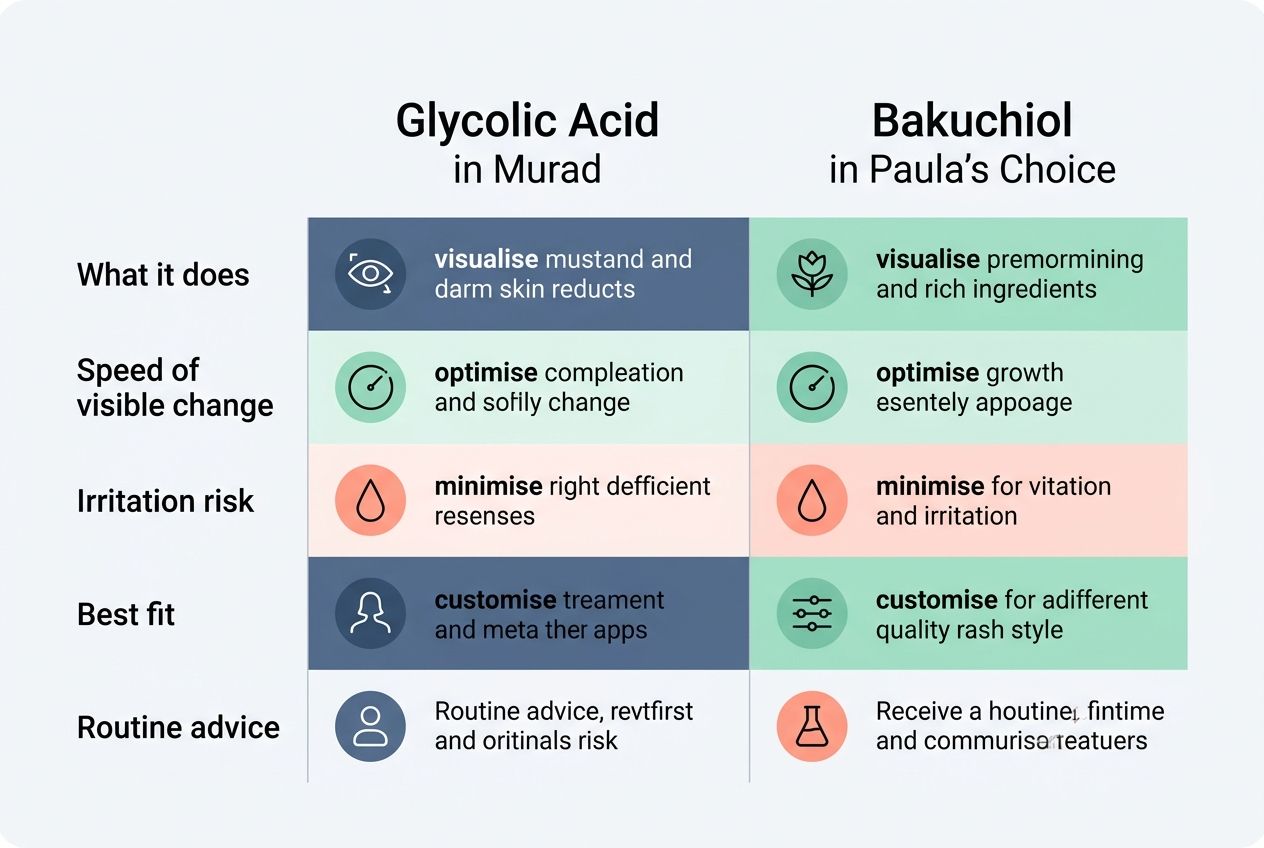
Glycolic Acid vs. Bakuchiol
| Feature | Glycolic Acid in Murad | Bakuchiol in Paula’s Choice |
|---|---|---|
| What it does | Exfoliates surface cells to improve dullness and rough texture. | Supports smoother, more even-looking skin without acting as a conventional retinoid. |
| Speed of visible change | Can make skin look smoother sooner because it works at the surface. | Usually works more gradually and relies on consistent use. |
| Irritation risk | Higher, especially if your routine already includes retinol, acids or benzoyl peroxide. | Usually lower, though sensitive skin can still react. |
| Best fit | Resilient skin with brown spots, rough texture and dullness. | People who want anti-ageing support but do not want a strong acid-led serum. |
| Routine advice | Start once daily or every other day and avoid stacking several exfoliants. | Introduce gradually, then pair with moisturiser and daily SPF. |
Glycolic acid can produce a quicker polished look, but that benefit disappears if you overuse it and trigger inflammation. Bakuchiol is less likely to give an immediate texture change, yet it is easier to keep in a long-term routine.
Tranexamic Acid vs. Niacinamide
| Feature | Tranexamic Acid | Niacinamide |
|---|---|---|
| Primary role | Targets the pathways linked to visible hyperpigmentation. | Supports more even tone, barrier function and a calmer skin appearance. |
| Where it appears here | Murad includes it with glycolic acid and 4-ethylresorcinol. Paula’s Choice uses it at 3%. | Paula’s Choice uses it at 5%, a recognised level for tone and barrier support. |
| Best for | Stubborn brown spots, sun-related marks and uneven pigment. | Marks paired with redness, oiliness, dehydration or a weakened skin barrier. |
| Routine compatibility | Works well with sunscreen and can sit alongside vitamin C or azelaic acid. | Generally layers well with vitamin C, retinol, azelaic acid and moisturiser. |
| Main limitation | It cannot replace sun protection or treat every cause of skin discolouration. | It is supportive rather than strongly exfoliating, so textured pigmentation may fade more slowly. |
For most people, tranexamic acid provides the direct dark-spot focus, while niacinamide makes the routine easier to tolerate. Paula’s Choice combines both in one formula, whereas Murad places more emphasis on resurfacing through glycolic acid.
Performance and Results
Both serums can help with hyperpigmentation, but their result timelines are different. Murad is designed to show an earlier visible shift in radiance and texture, while Paula’s Choice asks for steady use over several weeks.
Effectiveness on dark spots (Performance)
Murad reports clinical improvement in the look of dark spots after seven days. Its UK product page also states that 84% of participants showed a reduction in the look of dark spots after 14 days when using a Murad regimen.
That makes Murad appealing if your skin tolerates glycolic acid and you want to target existing brown spots with a more intensive formula. The number does not mean every mark will disappear in two weeks, especially deeper melasma or long-standing post-inflammatory hyperpigmentation.
Paula’s Choice is less focused on rapid resurfacing. It is better framed as a daily maintenance serum that helps fade uneven tone while supporting the skin barrier.
Timeframe for visible improvements (Performance)
Expect Murad to show changes in glow and smoothness first. The brand reports 91% saw brighter skin and 94% noticed smoother skin after 14 days with its regimen, with wrinkle and texture improvement listed at 28 days.
Paula’s Choice states that 8 to 12 weeks of daily use is the general timeframe for results. Red or pink post-blemish marks may fade sooner than grey, brown or very dark marks.
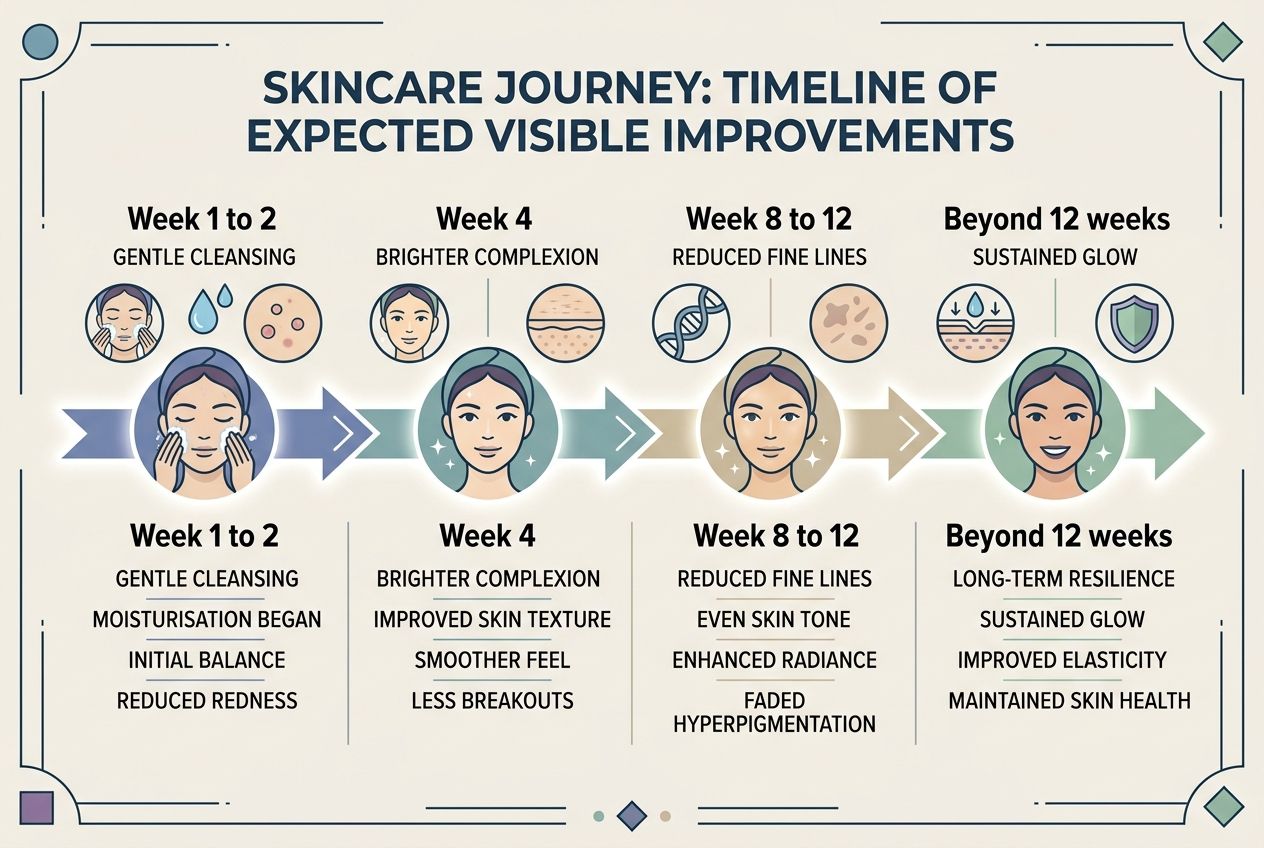
- Week 1 to 2: Murad may improve surface radiance and smoothness if your skin remains calm.
- Week 4: Check the same marks in the same lighting, rather than relying on day-to-day mirror checks.
- Week 8 to 12: This is the fairest point to assess Paula’s Choice on stubborn pigmentation.
- Beyond 12 weeks: Keep using SPF and maintenance treatment if your marks are linked to melasma, acne or sun exposure.
Texture and Application
Both products are designed to sit comfortably under moisturiser, sunscreen and makeup. The real application difference is not thickness, it is how carefully you need to introduce the actives.
Absorption and layering with other products (Texture & Application)
Paula’s Choice has a lightweight, silky serum texture that the brand says does not pill under other products. Its formula is easy to place after water-based treatments and before moisturiser.
Murad also absorbs quickly, but its glycolic acid and alcohol denat. make routine planning more important. Use a gentle cleanser and moisturiser around it, especially during your first two weeks.
- Cleanse with a mild, non-scrubbing cleanser.
- Apply one dark spot serum to dry skin.
- Follow with a simple moisturiser.
- In the morning, finish with broad-spectrum SPF 30 or higher.
Do not apply both serums in the same routine at first. Each already contains tranexamic acid, and combining them adds more variables without a clear need.
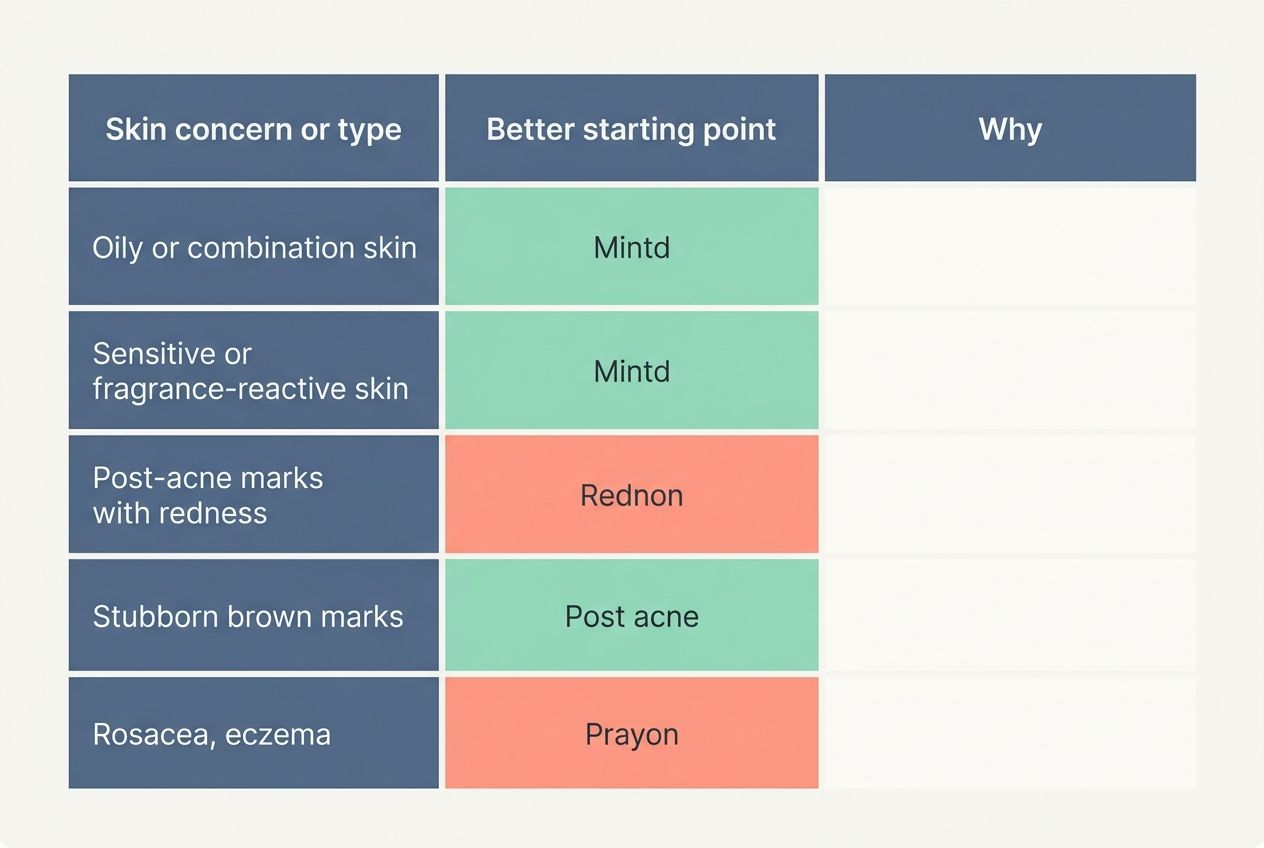
Suitability for different skin types (Texture & Application)
| Skin concern or type | Better starting point | Why |
|---|---|---|
| Oily or combination skin with rough texture | Murad | Glycolic acid can help improve dull, uneven-looking surface texture while targeting dark spots. |
| Sensitive or fragrance-reactive skin | Paula’s Choice | It is fragrance-free and does not rely on glycolic acid as the main active. |
| Post-acne marks with redness | Paula’s Choice | Niacinamide and tranexamic acid make sense for a gentler, long-term approach. |
| Stubborn brown marks with dull skin | Murad | The glycolic acid, tranexamic acid and resorcinol blend offers a more intensive approach. |
| Rosacea, eczema or a compromised barrier | Paula’s Choice, with care | It is the lower-risk option of the two, but patch testing and gradual use still matter. |
Neither product is a treatment for psoriasis, eczema, perioral dermatitis or seborrhoeic dermatitis. If these conditions are active, stabilise the flare with advice from a clinician before adding pigment treatments.
Price and Value
Price matters because fading dark spots needs consistency. A serum that looks impressive but is too expensive to replace is rarely better value than one you can use daily for three months.
Cost per bottle
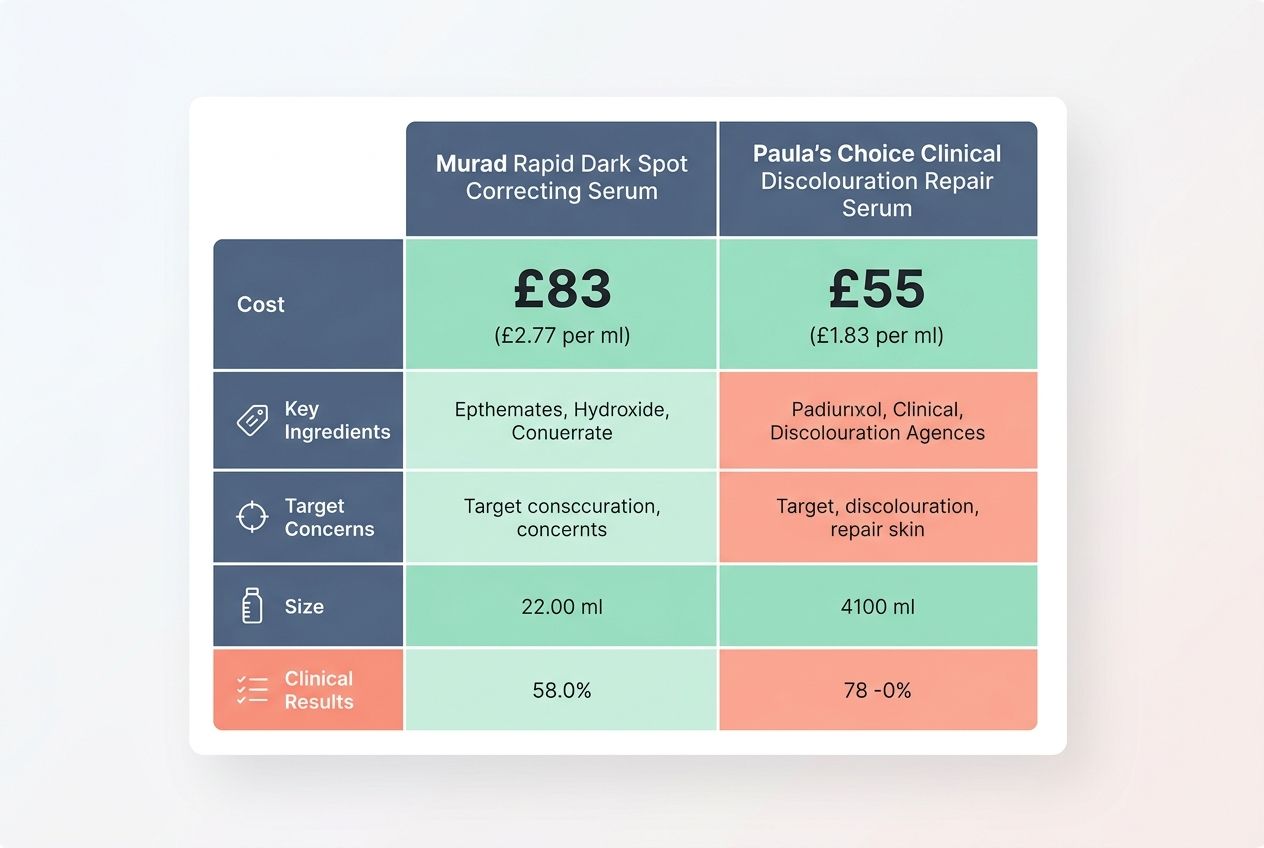
As of August 2026, Murad lists its 30 ml Rapid Dark Spot Correcting Serum at £83 in the UK. Paula’s Choice lists its 30 ml Clinical Discolouration Repair Serum at £55.
| Product | Size | Listed UK price | Approximate cost per ml | Value case |
|---|---|---|---|---|
| Murad Rapid Dark Spot Correcting Serum | 30 ml | £83 | £2.77 | Worth considering if you value faster-looking texture and radiance changes. |
| Paula’s Choice Clinical Discolouration Repair Serum | 30 ml | £55 | £1.83 | Better value for a slower, fragrance-free pigment routine. |
Paula’s Choice costs about 34% less per ml at these listed prices. Its direct UK store also advertises a 60-day money-back guarantee, which reduces the risk if you are unsure how your skin will respond.
Longevity of use
How long either bottle lasts depends on whether you apply it to your face alone or include the neck and chest. Paula’s Choice describes a pearl-sized amount, while Murad advises an even layer over the face, neck and chest.
If you use a small amount once daily, a 30 ml bottle can often support an 8 to 12 week assessment period. Twice-daily use or applying down the chest will shorten that window.
- Use Paula’s Choice once daily at first, then assess after 8 to 12 weeks.
- Use Murad once daily if you are new to glycolic acid, then increase only if your skin stays calm.
- Take a monthly photo in the same natural light to judge progress fairly.
- Put part of the budget into sunscreen, because pigment prevention protects the value of either serum.
Conclusion
Murad vs. Paula’s Choice Dark Spot Serum comes down to intensity versus gentleness. Murad Rapid Dark Spot Correcting Serum is the better fit if you want a stronger dark spot serum for brown spots, rough texture and a faster-looking glow, and your skin already handles glycolic acid well.
Paula’s Choice Clinical Discolouration Repair Serum is the smarter choice if you want fragrance-free skincare, 5% niacinamide and a steadier routine for uneven skin tone.
Whichever you choose, give it enough time, avoid piling on too many active ingredients and use SPF every morning. That is what gives dark spot correctors a fair chance to work.

FAQs
1. Which serum works better for dark spots, Murad or Paula's Choice?
It depends on the key ingredients and your skin type. Murad often uses stronger actives for faster fading, Paula's Choice favours gentler, evidence-backed actives like vitamin B3 and mild acids.
2. Is either serum better for sensitive skin?
Paula's Choice usually suits sensitive skin, it often has gentler formulas and less fragrance.
3. How soon will I see results?
Expect to see change in four to twelve weeks, depending on ingredient strength and how often you apply the dark spot serum. Use daily sunscreen and avoid mixing strong acids without advice. Do a patch test first, and stop if you get irritation.
4. Which offers better value in a full comparison?
Price does not guarantee better results, that is a common myth. Paula's Choice often gives better value across its range, while Murad can cost more but may act faster, so pick by ingredients and your skin goals.